 New
NewFirst Read Studio
A new kind of studio for filmmakers, documentarians and creators. Write, plan, rehearse, pitch and publish from one project that stays on your Mac.
$19.99/mo Coming soon
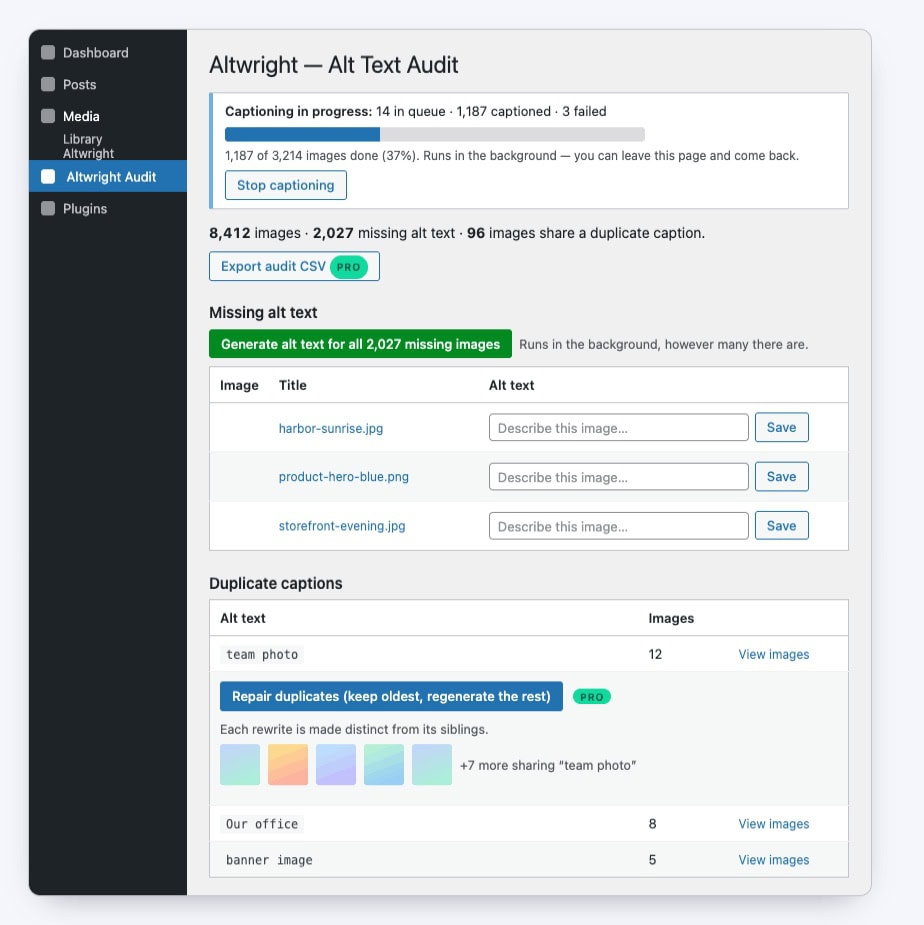
AI alt text that stays unique. Find every duplicate and missing description in your media library, fix them in one click, and prove it.

| Feature | Free | Pro |
|---|---|---|
| AI alt text generation (bring your own key) | ✓ | ✓ |
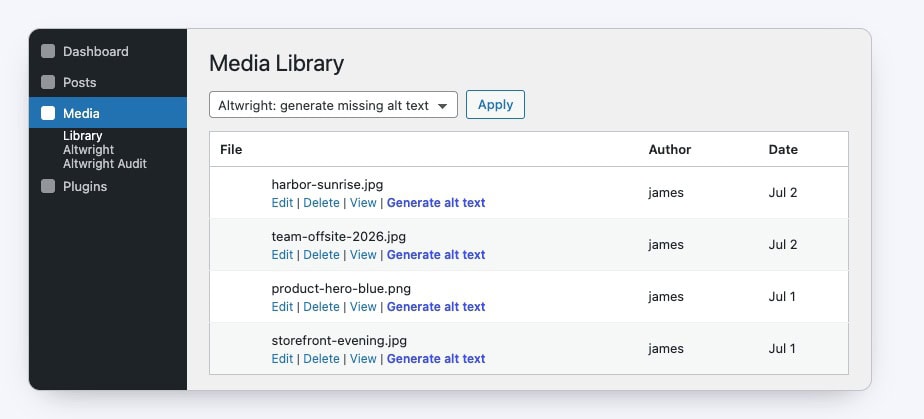
| Caption a single image from the Media Library | ✓ | ✓ |
| Bulk-caption selected images | ✓ | ✓ |
| One-click "caption everything missing" — no limits | ✓ | ✓ |
| Live progress bar with Stop button | ✓ | ✓ |
| Never overwrites existing alt text | ✓ | ✓ |
| Library-wide duplicate caption detection | ✓ | ✓ |
| Missing-alt audit with inline editing | ✓ | ✓ |
| Writes in your site's language automatically | ✓ | ✓ |
| Choose any caption language | — | 16+ languages |
| AI models | Claude Haiku 4.5 | Claude, ChatGPT & Gemini |
| One-click duplicate repair | — | ✓ |
| Sibling-aware rewrites (each caption made distinct) | — | ✓ |
| "No two identical" uniqueness enforcement | — | ✓ |
| CSV audit export for WCAG/ADA records | — | ✓ |
| Per-language alt text for Polylang / WPML / TranslatePress | — | Coming soon |
Plenty of tools will generate alt text for you. That’s not the hard part anymore — AI made writing a caption easy. The problem is that most of those tools create a new mess while clearing the old one: they fill every empty field, but they fill a lot of them with the same generic line. Now you’ve got a thousand images that all say “a person standing in a room.” That fails accessibility guidelines, it confuses search engines, and it stays invisible until someone audits you.
Altwright is built around the part everyone else skips: keeping every description unique, accurate, and accountable — across your whole library, and over time.
A few things make it genuinely one of a kind:
Most tools help you add alt text. Altwright makes sure it’s actually good — and keeps it that way.
Every image on your site is supposed to have a short written description — its alt text. It’s what a screen reader speaks aloud to someone who can’t see the image, and it’s what Google and the new AI search engines read to understand your pictures. Most websites are a quiet mess: images with no description at all, or the exact same description copied across dozens of them.
Altwright Free shows you the whole picture and lets you start fixing it — at no cost, using your own AI account, so there’s never a per-image charge from me.
Free isn’t a locked demo. It’s the real tool for finding your alt text problems and fixing them by hand.
Finding a hundred duplicate descriptions is one thing. Fixing them all — and keeping them fixed as your site grows — is another. That’s what Pro is for.
I didn’t set out to build an alt text plugin. I set out to build my own website, and somewhere around the four thousandth image, the website started talking back.
A film career generates pictures the way a farm generates work. Set photos, stills, press shots, behind-the-scenes frames from fifteen years of productions. When I rebuilt jameskicklighter.com from scratch last year, I wanted every one of those images to be findable, by people using screen readers, by Google, and by the AI search engines that are quickly becoming how people discover anything at all. That meant alt text. Real descriptions, on every image.
So I audited my own media library, and what I found embarrassed me. Hundreds of images with no description. Worse, hundreds more that shared the exact same one, copied and pasted on a deadline years ago and never touched again. Every tool I tried to fix it made the second problem bigger while solving the first. They’d fill the empty fields fast, then fill them with the same generic sentence, over and over. I’d traded one mess for a tidier-looking mess.
I grew up in a town of 123 people in south Georgia, where if a thing needs doing right, you generally end up doing it yourself. So I built the tool I needed. One that scans the whole library, shows you every gap and every duplicate, and rewrites each description to actually stand apart from its neighbors. Twelve photos from the same shoot should read like twelve different photos, because they are.
Then I realized the problem I’d solved wasn’t a filmmaker problem. It belongs to anyone with a photographer’s archive, a shop full of product shots, a restaurant’s food gallery, a nonprofit’s decade of event photos. Every site accumulates images faster than anyone can describe them, and every site owner I talked to had the same quiet mess I did. They just hadn’t looked yet.
Altwright is my way of handing you the tool I wished someone had handed me. Look for free. Fix it when you’re ready. And know that every image on your site can finally speak for itself.
NewA new kind of studio for filmmakers, documentarians and creators. Write, plan, rehearse, pitch and publish from one project that stays on your Mac.
 Free
FreeLog every set, track every personal record, and build the consistency that compounds over time. Free. No subscription.
 Bestseller
The Kicklighter hangs comfortably at any length. A zipper closure and back pocket make this bag the ultimate in practical style.
“In honor of its namesake James’s commitment to shouldering his friends’ burdens, no matter the size.” — Nancy Gale, JAMAH