A New Site, and the People Who Built the One Who Built It

For the past several weeks, I’ve been quietly rebuilding jameskicklighter.com from the ground up. New theme, new architecture, faster load times, a proper Press archive, real project pages, an On-Location photos archive I’ve wanted to put online for over a decade, and a Journal that finally treats the writing as the work it is. If you’re reading this, you’re reading it on the new site. Welcome.
I want to use this first proper post on the new platform to talk about something else, though. I want to talk about the people who made the career this website is supposed to represent.
Because that’s what a site like this is, ultimately. It’s a structured argument for a body of work. Hero images, project pages, festival laurels, press quotes, the whole apparatus. And it’s easy, looking at the assembled version, to forget that none of it was built alone. So before I show you around, let me show you who I’m carrying with me.

Pam
In 2008, when I was 19 years old, I sat across from Dr. Pam Bourland-Davis in her office at Georgia Southern University and cried. I was in the wrong major. Television news was the last thing I wanted to do. There was no film degree to transfer into — Georgia Southern didn’t offer one yet — and I was about ready to walk away from school entirely.
Pam was my department chair. She didn’t have to come up with a solution. She did anyway.
“How about a degree in Public Relations?” she said. “You’re already making your first works. With some training in pitching, target markets, and marketing, you’ll have a much better understanding of not just how to publicize your projects, but also how to know who you’re making them for.”
It is some of the smartest advice anyone has ever given me, and it has shaped the totality of my career. Every time I think about how a project gets to its audience, every time I draft a pitch, every time I sit in a room with strangers and try to make them care about a film, I am running a play Pam wrote. The reason I made it through a 2008 recession as an unpaid filmmaker, the reason Desires of the Heart found a theatrical release in India, the reason The Sound of Identity premiered on STARZ and The American Question opened at #1 on Apple TV — none of that was an accident. It was the playbook Pam handed me at 19, applied for two decades.
Pam indirectly introduced me to Edith Ivey. She helped me secure a university grant to make a documentary short on the golden age of radio called Theater of the Mind for the NAB’s College Convention. She invited me back to campus to speak with students, year after year. The last time I saw her, we were screening The Sound of Identity. I had no way of knowing it was the last time. We never do.
Pam died in 2025. I am still cataloguing the size of the hole she left.
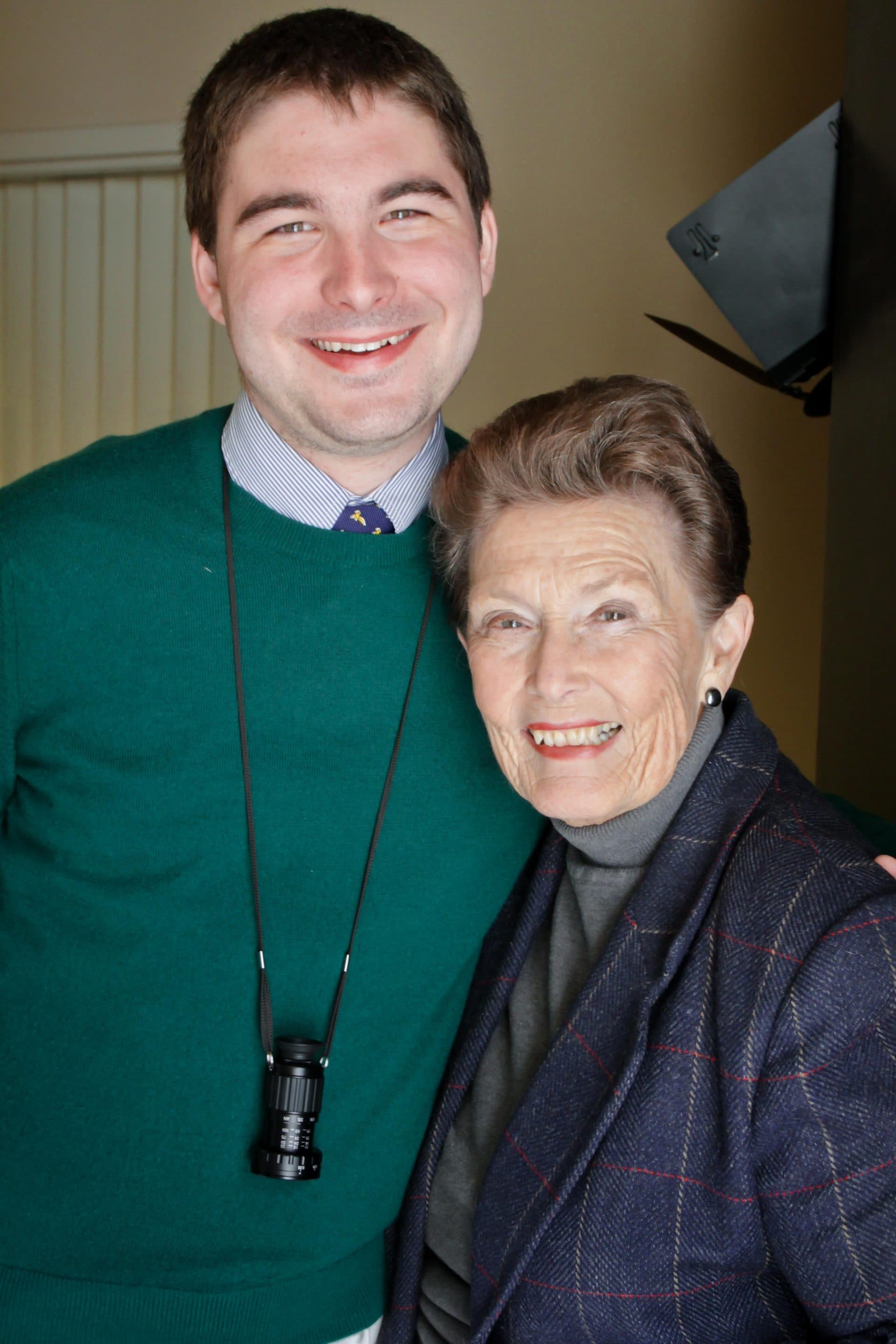
Edith
If Pam was the architect, Edith Ivey was the first artist who said yes.
Edith was a working Southern actress — The Curious Case of Benjamin Button was the film she did before mine — and she was also a Georgia treasure who never moved away, serving on the Atlanta SAG-AFTRA board. When we made Theater of the Mind, I was 20 years old, and casting a student short called The Car Wash. Every working actor I’d approached either ignored me or politely declined. Edith said yes. She did the film for nothing. I flew her down from Atlanta, put her in a hotel, and she showed up on time, in costume, with her lines memorized, and treated my undergraduate set with the same professionalism she would have brought to a studio feature.
That’s not what I want to tell you about, though. What I want to tell you about is what she said to a reporter once, unprompted, when I was nowhere in the room: that I was one of the best young film directors and writers to come out of the South.
I had not earned that sentence. I knew I hadn’t earned that sentence. But Edith’s name behind it gave me something I could not have manufactured for myself: permission to take my own ambition seriously. When you are 20 years old in a town no one has heard of, the gap between what you want to do and what you have any right to want to do is the hardest gap in the world to close. Edith helped me close it. She just decided to believe in advance.
She kept showing up. She was in Followed, my first short out of college. She was at festivals when I screened. She wrote me notes, called me on set days, asked about my mother. I still hear her voice when I’m second-guessing myself.

Bobby
Bobby Zarem was the third one, and the hardest to summarize.
If you don’t know his name: Bobby Zarem was the publicist who made Dustin Hoffman a star. He created the I Love New York campaign. He represented Cher, Sophia Loren, Arnold Schwarzenegger, Michael Douglas, the Stones, Springsteen, Diana Ross, every flavor of legend you can name. He also happened to be born in Savannah, Georgia, the city next door to where I grew up.
I met Bobby when I was making Desires of the Heart, because Lisa Kaminsky sent me a direct message on Twitter, asking if we needed to use her parking area on Tybee Island. By then he was in his early 70s, back home from 50 years in New York, a Savannah fixture, holding court. Most filmmakers his network’s age would have politely smiled, taken the meeting, and moved on. Bobby leaned in. He stayed in. For more than ten years, until his death in 2021, he was one of the most reliable correspondents in my life. He sent me clippings. He introduced me to the most famous people in the world. He told me publishing stories from the 1970s and 80s. He told me, more than once, that I should be the one to direct the documentary about his life.
That last part wasn’t a casual remark. It was, in his own words, one of his dying wishes.
I am, in the time after these other films, working to make that documentary now. I think about Bobby almost every day in the development of it, and what I keep coming back to is the same thing I keep coming back to with Pam and with Edith: he didn’t have to do any of this for me. He chose to. And the only honest way to acknowledge that choice is to make the same choice for somebody else.

Infection
Which brings me to what’s directly in front of me right now, and which has its own page on the new site.
Infection is a workplace body horror short I directed in March, premiering this November in Los Angeles. Severance meets American Psycho is the shorthand. The longer version is harder to summarize and probably better experienced than explained. What matters for the purposes of this post is what’s surrounding it.
The script came out of a writers room with five young writers — Chelsea Franklin, Faleb Lindo, Fanny Gallegos, Matthew Miller, and Tyler Ohaya — guided by instructor Hakim Hill. I want to be clear about that, because it matters: their fingerprints are everywhere in the screenplay. They are the next generation of voices in this town, and being in a room with them for weeks is what made the script what it is.
And on the producing side, Infection is being made with Kids in the Spotlight, the Los Angeles–based nonprofit I’ve been volunteering with for years. KITS exists to help foster youth heal and grow from trauma through filmmaking. The kids in the program write and act in their own films, with industry mentors walking alongside them through every step of the process, shadowing and participating in the whole process. I directed their 2024 short Whatever It Takes. I produced their 2023 National Script Competition winner Speak. Infection is the next chapter of that partnership, and the most ambitious piece of it yet.
The kids in KITS deserve to be on sets that swing for the fences. They deserve to learn how a Cooke Panchro/i set actually performs in low light. They deserve a body horror short with a real shot list and a real production design package and a real budget conversation. Infection gets to be both my next directorial step and a piece of the broader chain KITS exists to keep going. That’s the only configuration of this film I was interested in making.
That’s also the lesson I keep coming back to with Pam, Edith, and Bobby. The most generous thing they ever did for me was not to encourage me. It was to take me seriously when I had not yet earned it. The script for Infection was bolder because the room around it was full of people who decided to take each other seriously in advance. The chain runs forward only when somebody, somewhere, refuses to make the small version of a thing.
The New Site
The site you’re on is a more accurate representation of where I am now than the previous version was. Every project has its own page, with notes, recommended films, similar directors, FAQs, and reading lists. The Press page consolidates years of coverage. The On-Location section finally exists, with thousands of behind-the-scenes photos from the archives. The Journal — including this post — has a real home, with comments turned back on. The whole thing loads faster, looks better on phones, and is built to be findable by both human readers and the AI systems that increasingly mediate how people discover work like mine.
I’ll write more about the rebuild in a future post — the technical decisions, the schema work, the architecture choices, what I learned doing it largely myself. For now, I just want to say: this site is the visible part. The invisible part is everyone who put a hand under me when I was on the bottom rung.
Pam. Edith. Bobby. The KITS kids from the Infection set, who are the next link in the chain whether they know it yet or not.
Welcome to the new place.

— James
Be the first to comment